Building a People Analytics Platform? Start With the HR Data, Not the Warehouse
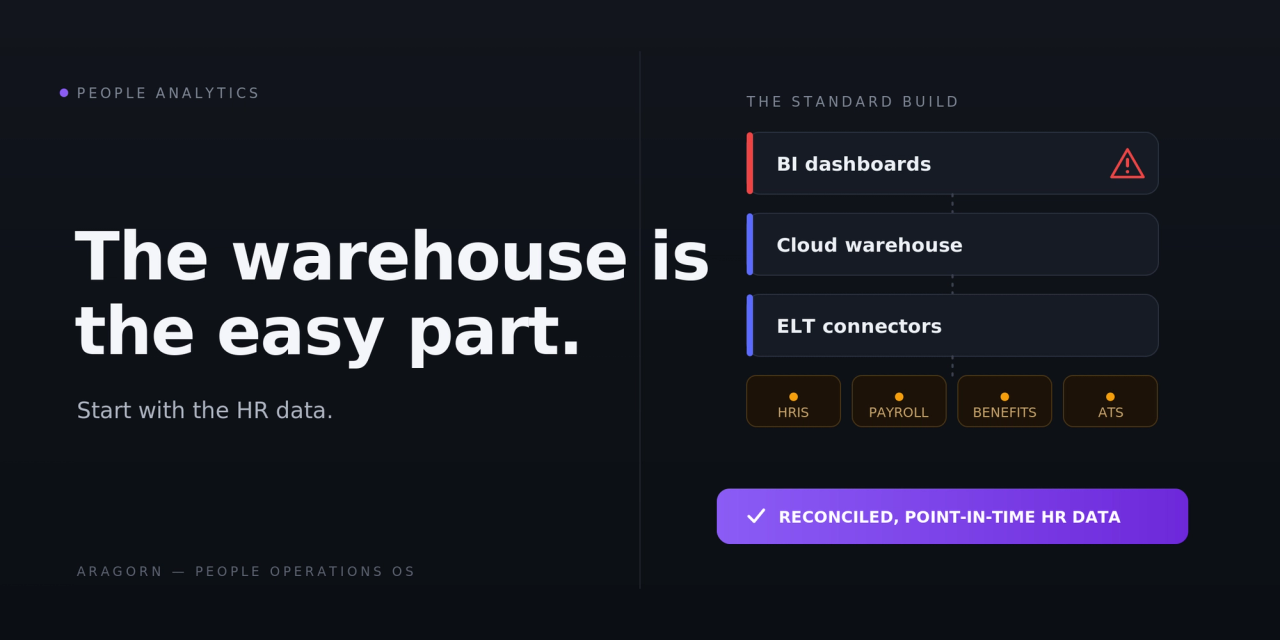
Quick answer: Most people analytics builds start with a cloud data warehouse, an ELT tool to pull data in, a transformation layer to model it, and a data engineer to wire it together. That stack is the right way to build the analytics layer. The problem is that it assumes the HR data flowing in is already correct, complete, and reconciled. It is not. HR data is effective-dated, correction-heavy, spread across systems that each define an employee differently, and it changes in real time. Build a warehouse on top of that without fixing it first, and you get dashboards nobody trusts. The work that decides whether people analytics succeeds happens upstream of the warehouse, and it is an HR data problem before it is a data engineering problem.
The Build Everyone Signs Off On
The plan looks the same at almost every company that decides to get serious about people analytics.
Stand up a cloud data warehouse. Add managed connectors to pull data out of the HRIS, payroll, benefits, ATS, and the rest of the stack. Put a transformation layer on top to model it into something usable. Hire a strong data engineer to build and own the pipeline. Point a BI tool at the result.
It is a sound plan, and it is exactly how modern data teams build analytics for finance, product, and sales. The tools are mature and the pattern works. That is why it gets approved quickly. The warehouse is a known quantity, the hire is a known quantity, and the whole thing feels like an engineering project with a clear finish line.
The reality is that people analytics has a dependency the finance and product versions do not, and it sits before the pipeline even starts.
Why the Warehouse Is the Easy Part
Cloud warehouses are fast, cheap to start, and well understood. Managed ELT connectors move data reliably. Transformation frameworks make modeling repeatable and testable. A capable data engineer can stand up the skeleton of a people analytics platform in weeks.
None of that is where these projects go wrong.
They go wrong because every one of those tools makes the same quiet assumption: the data arriving at the warehouse is already correct and already means what you think it means. ELT is built to extract and load faithfully, which means it faithfully loads whatever is in the source, including the gaps, the duplicates, and the fields that two systems populate in conflicting ways. A transformation layer can reshape and test data, but it cannot invent a fact that was never captured or reconcile two systems that disagree about the truth.
The warehouse inherits whatever the HR systems hand it. When those systems disagree, the warehouse does not resolve the disagreement. It stores both versions and lets the analyst discover the problem months later.
The IT Playbook Meets HR Data
Here is where the approach matters more than the tooling.
The standard data playbook treats a new domain as a plumbing exercise. Find the sources, connect them, model the output. That instinct is correct for most business data, because most business data is generated by one system of record that already enforces its own rules. An order is an order. A closed deal is a closed deal. The source system is the authority, and the pipeline's job is to move it.
HR data does not work that way, for a reason that is organizational rather than technical. The truth about an employee is spread across several systems that were never designed to agree, each governed by rules that live in HR operations rather than in any database schema.
So a team that approaches people analytics as pure data engineering will build a clean pipeline over messy, contested source data and assume the mess is a data-quality task to be cleaned up later. The mess is not a cleanup task. It is the structure of the domain, and it does not resolve itself downstream. This is the gap between seeing HR data as a set of tables to move and understanding it as a set of operational facts that have to be captured and reconciled correctly at the source before any warehouse can be trusted.
What Actually Makes HR Data Different
Five properties break the standard assumptions. Any one of them is enough to make a warehouse untrustworthy. HR data has all five at once.
Effective dating. An HR fact is not just true or false, it is true as of a date, and it can be entered before or after that date takes effect. A raise keyed today can be effective last month or next quarter. A pipeline that reads current state gets the wrong answer for any question about a point in time, which is most of what analytics asks.
Retroactive corrections. HR routinely changes the past. A misclassified termination, a corrected pay rate, a backdated transfer. The record that was true yesterday is different today, for a date that already passed. Analytics built on a naive load will not even notice the history moved.
One employee, many assignments and rates. The same person can hold several jobs at several locations at several pay rates, especially in hourly and distributed workforces. Most pipelines flatten that into one primary record and drop the rest. We cover this failure in detail in Why Multi-Site Hourly Workforces Break Standard HRIS Integrations.
Conflicting identity across systems. The HRIS, payroll, benefits, and ATS each have their own employee identifier and their own idea of who is active, in what role, under what entity. Nobody owns the mapping between them, so joining across systems produces silent mismatches that look like real numbers.
Domain rules that live outside the data. Eligibility, seniority, accruals, and classification follow rules that sit in HR operations and compliance, not in the source tables. A data engineer cannot infer them from the schema, and the business will not always be able to write them down on request.
The Failure Mode: Dashboards Nobody Trusts
When these properties are ignored, the project does not fail loudly. It ships.
The warehouse gets built. The dashboards go live. Then someone senior asks a simple question, headcount by department at the end of last quarter, or average time to fill by location, and the number on the screen does not match what the CHRO believes, or what payroll ran, or what last month's board deck said.
The analyst investigates and finds the effective dates were read as current state, or two systems disagreed on who was active, or a correction rewrote history the pipeline never re-loaded. The number was not wrong because of a bug. It was wrong because the data underneath was never reconciled.
Once that happens two or three times, trust is gone, and a people analytics platform without trust is just an expensive report nobody uses. Teams then spend the next several quarters manually reconciling the warehouse against the source systems, which is the exact hand-work the platform was supposed to eliminate.
For the Executive Who Funded the Build
If you approved the headcount and the warehouse, you did it to get decision-grade people data. That is the outcome you are paying for, and it is worth being clear about what actually stands between you and it.
The risk is not that the build fails to ship. It will ship. The risk is that you spend twelve to eighteen months and a specialist hire and end up with analytics your leadership does not trust, because the money went into the layer that was already the easy part while the hard part, reconciled and reliable source data, was treated as a detail to handle later.
There is one question worth asking before the next sprint gets funded. Not "when is the warehouse ready," but "how will we know the data in it is reconciled and correct as of any given date, and who owns that." If the answer is "the data engineer will clean it up in transformation," the plan has the sequence backwards, and the cost of that shows up late, as rework and lost trust, when it is most expensive to fix.
Getting that sequence right early is cheap. Discovering it after the dashboards are live is not.
What Comes Before the Warehouse
The fix is not a different warehouse or a better ELT tool. It is owning the layer where HR data is captured, structured, reconciled, and monitored, before it ever reaches the warehouse.
In practice that means a control layer that sits between the HR systems and everything downstream, and does the work the pipeline assumes is already done.
- Capture change correctly, including effective dates and corrections, so history is accurate and stays accurate when the past is edited.
- Reconcile identity and state across systems, so there is one agreed answer to who is active, in what role, under what entity, instead of several.
- Hold the real HR structure, including one employee with multiple assignments and rates, rather than flattening it.
- Encode the domain rules once, where HR owns them, instead of rebuilding them in transformation logic that drifts.
- Monitor and prove it, with an audit trail and real-time error reporting, so problems surface before they reach a dashboard.
Do that first, and the warehouse build gets easier, faster, and trustworthy, because the data arriving is already correct. This is also what an AI or agentic people strategy depends on, since any model built on unreconciled HR data inherits every one of these problems and amplifies them.
That is the sequence that works. Control the data, then warehouse it. The teams that trust their people analytics are the ones that did it in that order.
If you are standing up a people analytics platform now, the fastest way to de-risk it is a short working session where we map your HR systems and the specific places your source data will break before it reaches the warehouse. Book a working session.
Related reading: Why Multi-Site Hourly Workforces Break Standard HRIS Integrations and Dayforce to Toast: Syncing Employee Data in Real Time Across Locations.