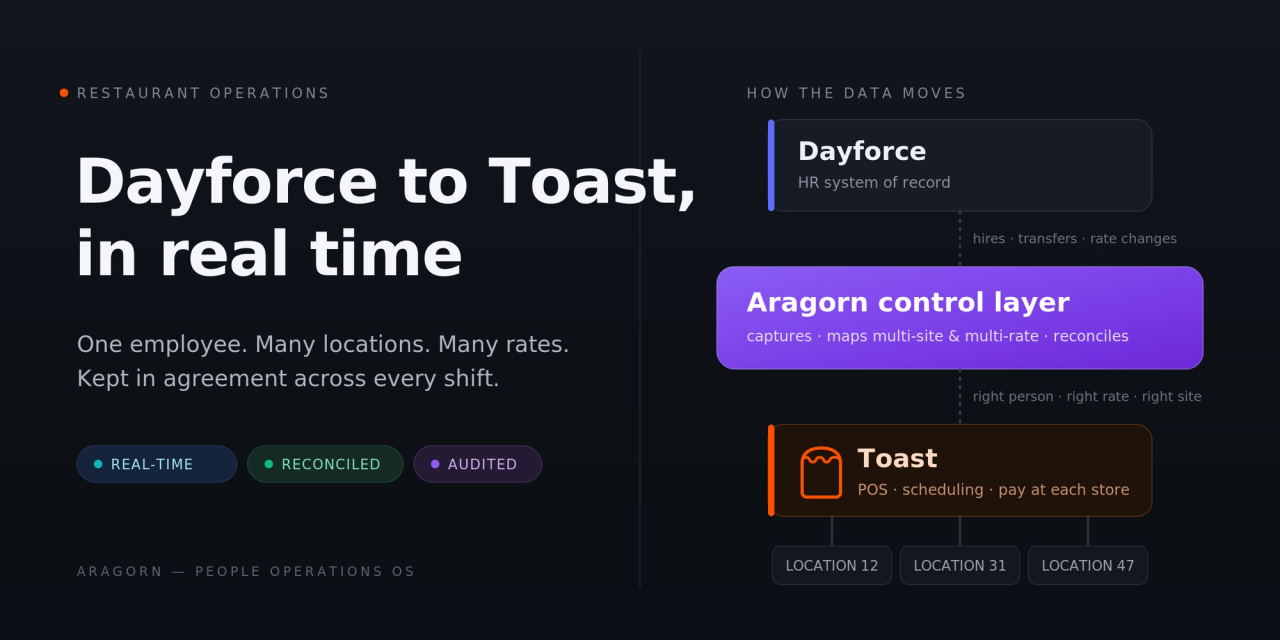
Dayforce to Toast: How to Sync Employee Data Across Multiple Restaurant Locations
The Short Version
If you run a multi-location restaurant group on Dayforce for HR and payroll and Toast at the store level, you need employee data to stay in agreement between the two, in real time, for people who work more than one site at more than one rate.
A nightly file does not cut it for an hourly workforce that hires, transfers, and changes rates every day. The reliable way to do it is a layer between Dayforce and Toast that captures each change as it happens, represents one employee across many locations and jobs correctly, and keeps both systems reconciled with a full audit trail. The rest of this page explains why and what to look for.
Why Dayforce and Toast Need to Talk in the First Place
Dayforce is your system of record for the employee. It owns hiring, job and pay data, payroll, and compliance. Toast runs the restaurant: point-of-sale, scheduling, time, and team management at each location.
For anything to work at the store, the employee has to exist correctly in Toast. They need to be set up with the right job, the right pay rate, and access to clock in and use the point-of-sale at the location they are actually working. That information starts in Dayforce when they are hired or when something about their employment changes.
So every new hire, termination, transfer, promotion, and rate change in Dayforce has to reach Toast, accurately, before the employee's next shift. When it does not, the store feels it immediately.
Why This Is Harder for Restaurants Than for Most Businesses
Most companies have a simple version of this. One employee, one job, one location, one rate, updated occasionally. That maps cleanly between any two systems.
Restaurant groups have the hard version, because the same employee routinely works more than one role at more than one site.
A team member might serve at one location, run a register at another, and pick up a shift at a third during a busy weekend. Each of those carries its own job code and its own pay rate, and the assignments change constantly as people swap shifts, cover sister locations, and get promoted at one site but not another.
That is a one-to-many record: one person, several jobs, several rates, several locations. Most integrations are built for a one-to-one record and quietly assume one job at one rate. When the one-to-many reality gets pushed through a one-to-one pipe, the integration tends to keep one rate and drop or overwrite the others. Dayforce still looks right. Toast pays the wrong rate at the wrong site.
Where the Dayforce to Toast Connection Usually Breaks
When restaurant groups trace the problems back, they cluster in a few predictable places.
- Pay rate by location and job. A rate change for one job silently changes another, or a second job gets created in Toast without its own rate. Employees notice on their paycheck, and that becomes a trust problem.
- New job or location assignment. A transfer reaches Dayforce but not Toast, so the employee shows up at the new location and cannot clock in or access the point-of-sale.
- Timing. A new hire starting a shift this afternoon cannot wait for tonight's batch file. Hourly operations run in real time, and the data has to keep up.
- Terminations and access. Someone is termed in Dayforce but stays active in Toast, which is both a payroll leak and a security gap.
None of these are unusual. The only real variable is how many hours your team spends each week fixing them by hand.
Batch Files vs Real-Time Sync
The most common way these two systems get connected is a scheduled file, often nightly. It works for a workforce that changes slowly. It does not work for a restaurant.
A nightly batch means a hire made at 2pm is not usable at the store until the next day. It means a rate change today is wrong on tonight's shift. It means a termination this morning leaves access open all day. For an hourly, fast-moving workforce, the gap between when something changes in Dayforce and when Toast knows about it is exactly where the errors live.
Real-time sync closes that gap. When something changes in Dayforce, the change reaches Toast in near real time, so the store can act on it the same shift. For this workforce, that timing is not a nice-to-have. It is the difference between a system that works and one that generates manual cleanup every day.
What "Good" Looks Like
A reliable Dayforce to Toast connection for a multi-location group does five things.
- Moves changes in near real time, not on a nightly batch, so the store can act the same shift.
- Represents one employee across many sites and jobs correctly, with the right rate for each, instead of flattening them into one primary record.
- Reconciles the two systems, so mismatches are surfaced and corrected instead of silently overwritten.
- Shuts off access cleanly on termination in both systems, with no leftover active accounts.
- Proves itself with an audit trail, flagging failures when they happen rather than at payroll, so HR can see what moved, where, and who it touched.
If a connection does all five, the reconciliation tax disappears and new location openings stop making everything worse.
Build It, Buy an iPaaS, or Use a Control Layer
There are three common ways to connect Dayforce and Toast, and they are not equal for this use case.
Build it with IT or a developer. Workable for a single, static mapping. The problem is that the HR logic, which rate belongs to which job at which site, what happens on a cross-location promotion, lives outside IT's domain, so every exception becomes a ticket and HR waits on a backlog. It also tends to be brittle when either system changes.
Buy a generic integration platform (iPaaS). An iPaaS moves data between systems reliably, but it assumes the data going in is already correct and already shaped the way Toast needs it. The hard part of restaurant employee data, the one-to-many model and the real-time reconciliation, is upstream of what an iPaaS does. You still have to build and own that logic somewhere.
Use a control layer built for HR data. This is a layer that sits between Dayforce and Toast and owns how the employee data is structured, moved, and monitored. It captures changes in real time, holds the multi-site model natively, reconciles both systems, and gives HR control without a developer. For a multi-location group with a one-to-many workforce, this is the model that actually fits the problem.
How Aragorn Connects Dayforce and Toast
Aragorn is the control layer between your HR systems and the systems that run each location. It sits between Dayforce and Toast and owns how employee data moves across them.
For a multi-location restaurant group, that means new hires, terminations, transfers, promotions, and rate changes flow from Dayforce to Toast in near real time. One employee working several sites at several rates is represented correctly in both systems, not flattened into a single record. Mismatches are surfaced and reconciled instead of silently overwritten. Every change carries an audit trail, and your HR or People Systems team owns the logic without filing an IT ticket for every exception.
The result is that the store always has the right people set up at the right rate for the right location, on the same shift the change happens, and your team stops spending its week reconciling two systems by hand.
The fastest way to see whether this fits your setup is a short working session where we map your Dayforce and Toast configuration and the specific places your employee data is breaking across locations. Book a working session.