The HRIS Unicorn Doesn't Exist. Stop Writing Job Posts for One.
Go read your open HRIS req. Odds are it asks for one person who knows HCM configuration, benefits administration, reporting, and integrations.
We asked a consultant who has implemented HR systems since 1998 and worked in Workday since 2014 how often she sees that person actually show up. Her answer: never. Companies look for one person who can do everything, and that person doesn't exist. Inside the industry the role even has a name, the unicorn, which should tell you something about the hit rate.
This piece is about why the unicorn doesn't materialize, what companies get instead, and why the gap you're hiring for is mostly a tooling gap wearing a job description.
Why the unicorn never shows up
HRIS talent comes off two different career tracks, and the tracks don't cross.
One track produces technical people. They can build a Studio integration, read a vendor file spec, and debug a failed feed, but they've never run an open enrollment and don't know why a benefits eligibility rule is shaped the way it is. The other track produces business people. They know the plans, the processes, and the politics cold, but they can't write an integration spec, and asking them to is how projects stall.
The consultant put it in one sentence: you either get an integrations person who needs the business knowledge, or a business person who isn't technical enough to spec an integration. Twenty-five years of implementations, and she has not seen the combination in one hire.
There's a reason for that. Each side of the req is its own discipline with its own multi-year learning curve. Benefits alone is a career. Workday integrations alone is a career. Expecting both in one salary band is like posting for a CFO who also writes production code. Such people exist as rumors.
What you actually get
Companies post the req anyway, and one of three things happens.
Most often the role goes to whoever is available. The consultant spent years at a major entertainment company cleaning up exactly this, an HRIS function that had been assigned to "the person who had nothing else to do." Second most often, you hire a real HRIS professional from one of the two tracks and the other half of the req goes quietly unstaffed. The gap surfaces at your first vendor change or your first broken feed, and the answer becomes a partner ticket.
The third outcome is the expensive one. You conclude the problem is seniority, reopen the req a level up, and spend another six months not finding the unicorn at a higher price.
In all three cases the integrations half of the job lands outside your team, with a partner or consultant, billed by the hour, on their queue. Which means the thing you were trying to hire your way out of, dependency on outside specialists for routine work, is exactly what you end up with.
The req is a spec for missing tooling
Here's the thing. When a job description demands deep skills in two unrelated disciplines, that's rarely a hiring problem. It's a sign the tooling forces a translation step that shouldn't exist.
The only reason you need an engineer-shaped human in HR is that integration logic lives as code. Someone has to translate "send Fidelity the employee's deferral percentage, derived from these two fields" into a transformation script. The business person can say the first half and can't write the second. The technical person can write the second and has to be told the first. The unicorn req is just asking for both halves of a translator.
Remove the translation step and the req collapses into a job that real people actually have. If integration logic is readable configuration, field mappings in business terms, validation rules against the vendor's spec, point-and-click derivations, then your strong business-side HRIS analyst covers it, because the work has become judgment instead of code.
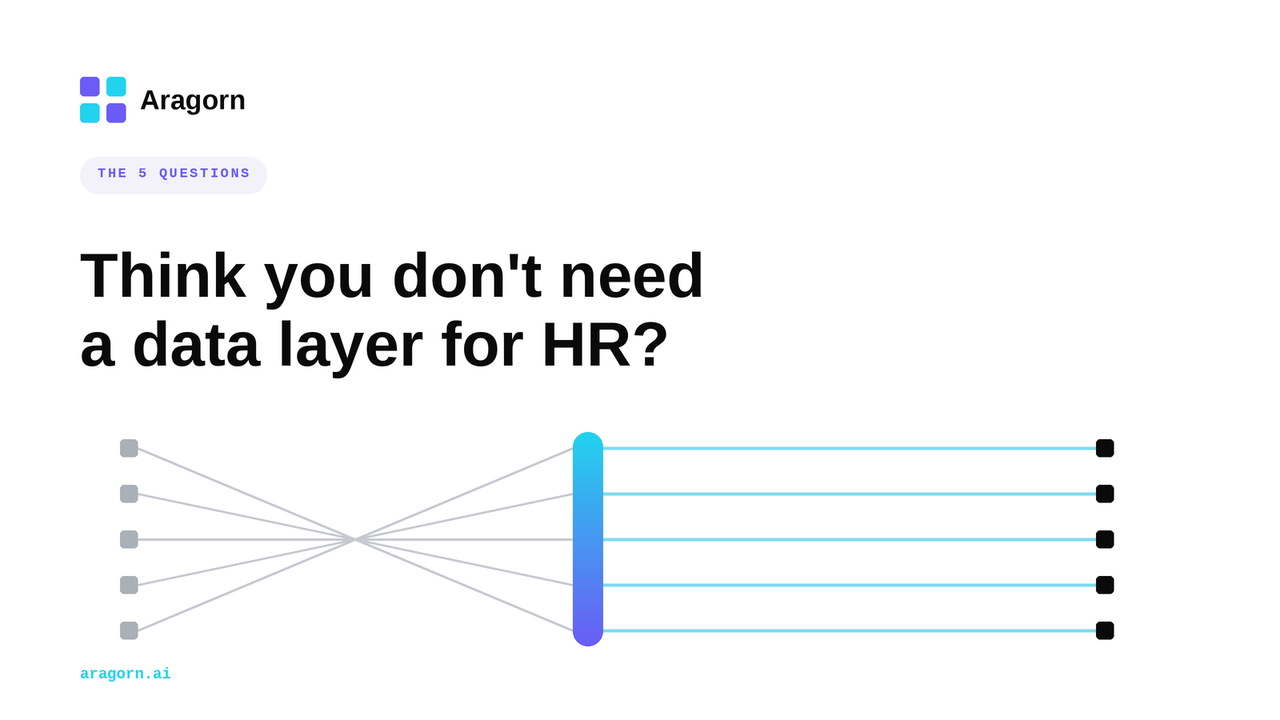
That's what Aragorn is for. It sits on top of Workday or any HRIS and surfaces every integration as configuration HR can read and change, with data validated against vendor specs before it ships. Plaid runs its HR integrations this way, a modern people team operating at technical-company standards without staffing integration engineers in HR.
Write the req for a human instead
If you're hiring for HRIS right now, the fix costs nothing.
Hire from the business track and screen for systems thinking, someone who understands your processes and can reason about how data should flow, even if they've never written a line of code. Drop the integration-development bullets from the req, because the candidates who claim them are the ones to be most skeptical of. Then close the technical gap with tooling your new hire can operate on day one, instead of a partner retainer they'll spend their first year managing.
The takeaway is simple. You've been trying to hire a workaround for your tooling. Fix the tooling and the people you can actually find become enough.
If you have an open HRIS req today, book a working session. We'll map your integration workload and show you which parts of that job description a normal human can run with the right control layer.