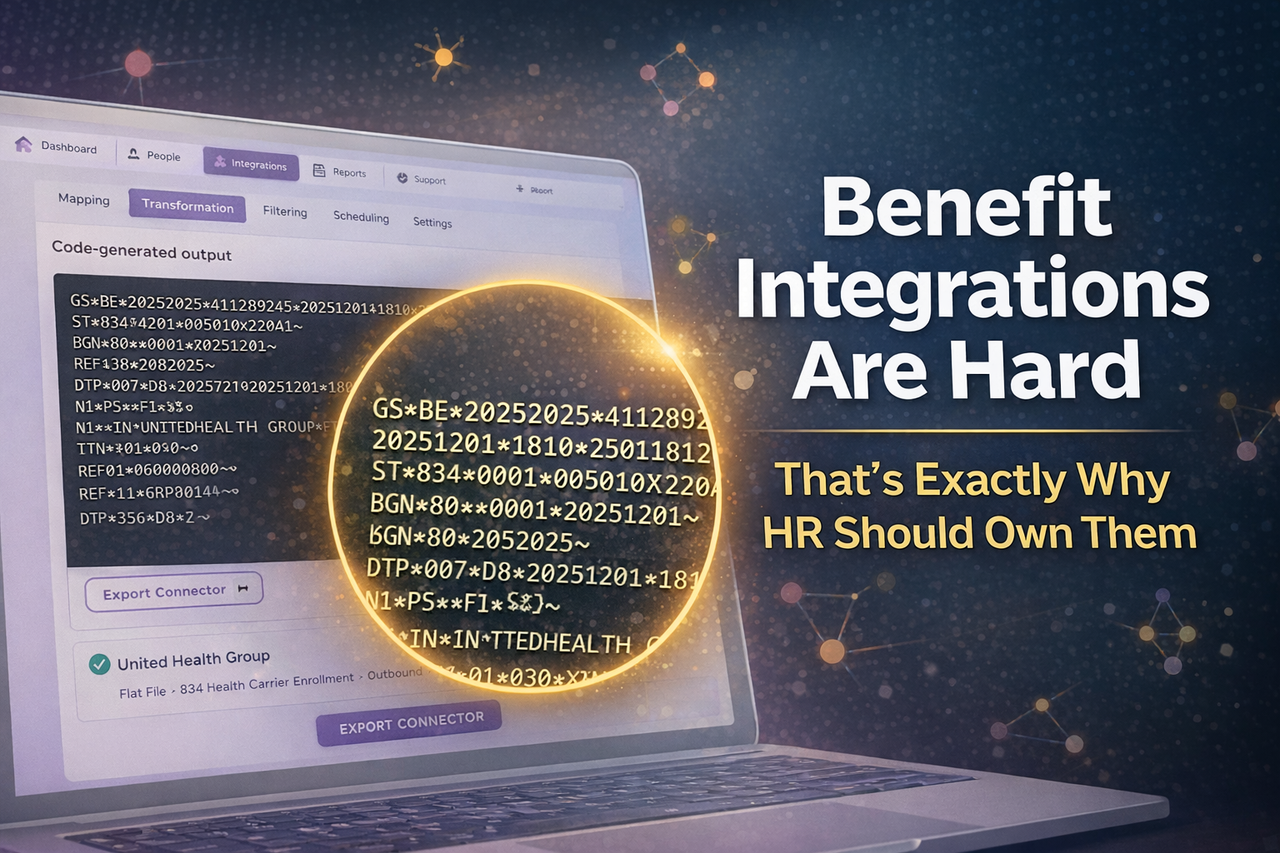
If you’ve ever looked at a benefits integration file and wondered who on earth designed it, you’re not alone. Rows of cryptic codes, fixed-width fields, appended dependent columns, mysterious delimiters—it can feel absurd. But there’s a reason benefit integrations look the way they do.
They’re trying to model real human complexity.
Making Benefit Integrations Simple — Featuring Gladys from Aragorn AI
Ever wonder why HR tech feels so disconnected? We’re diving into the "why" behind the friction and how we’re making seamless integrations the new reality.
Every benefits provider has its own proprietary EDI format. One vendor wants dependents appended as extra columns. Another expects them as a separate segment entirely. Some require specific status codes, spacing rules, or transformation logic just to interpret something as basic as “full-time.” Multiply that by dozens of vendors, each with their own quirks, and benefits quickly become one of the most complex integration challenges HR teams face.
Layer on top of that the reality that every organization defines HR concepts differently. What does “active” mean? When does eligibility begin? Which job counts as primary when an employee has multiple work assignments? These aren’t technical questions — they’re business and policy decisions HR teams already understand.
Historically, solving this meant handing all of that institutional knowledge to consultants or IT. HR explains the rules. Someone else translates them into code. Documentation piles up. Updates get risky. And over time, no one is quite sure which file or rule set reflects reality anymore.
At Aragorn, we started with a different question:
What if HR didn’t have to give up control of their knowledge to build integrations?
Instead of forcing HR teams to learn scripting languages or manage fragile documentation, the platform removes the technical barrier entirely. The complexity still exists — but it’s handled inside the connector. Vendor-specific formats, codes, and requirements are baked in. HR teams configure integrations using clicks, rules, and definitions that match how they already think.
One of the most powerful outcomes of this approach is giving organizations the ability to define their own HR data ontology — a living dictionary of what their data means. What makes someone active or inactive. How eligibility is determined. Which work assignment matters for which vendor. Once those definitions exist, they flow cleanly into every integration.
And yes, that means Aragorn can handle the truly weird cases too — like employees with multiple work assignments, vendor-specific manager relationships, and eligibility rules that change depending on context.
There’s nothing simple about HR. But it also shouldn’t be brittle, opaque, or locked behind technical gatekeepers.
Benefit integrations just happen to be the clearest example of what’s possible when HR teams are empowered with software that understands their world — and trusts them to run it.