

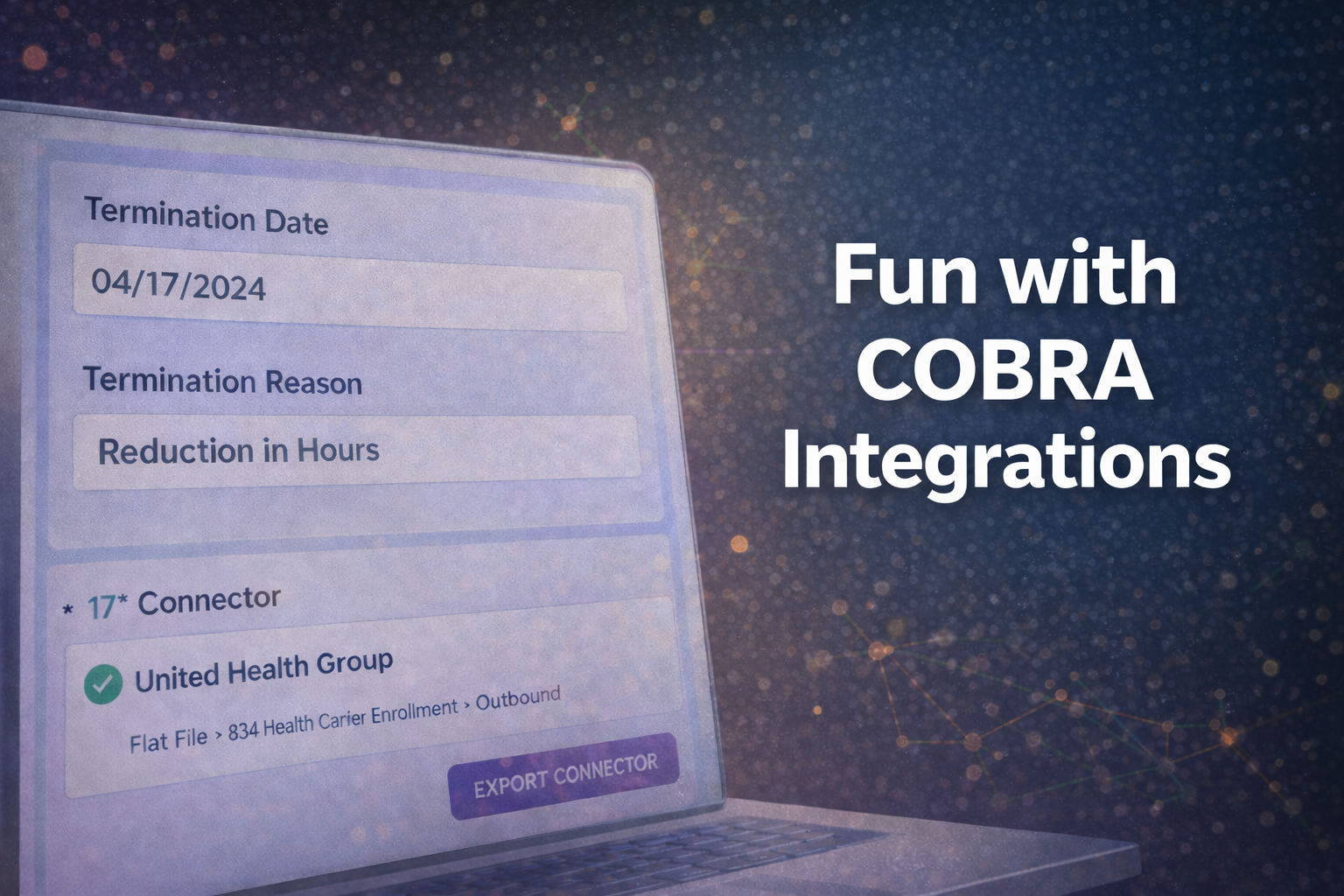
COBRA integration files are just one example of why HR teams need to be empowered to build and manage their own integrations. The alternatives are too slow and costly.
COBRA benefit enrollment is often treated like a simple data transfer: an employee leaves, their information gets sent to a COBRA provider, and coverage continues if they elect it. On paper, it sounds straightforward.
In practice, COBRA is one of the clearest examples of why HR teams need direct control over their integrations.
The complexity starts with qualifying events. Termination alone isn’t enough. Voluntary and involuntary terminations, reductions in hours, retirements, leaves that never convert back to active employment, divorces, and dependent life events can all trigger COBRA eligibility. Even exclusions—like gross misconduct—must be handled carefully. Each organization tracks these scenarios differently inside their HR system, often across multiple fields, codes, and historical records.
This is where traditional integration models break down. HR knows the rules. They understand exactly which scenarios should trigger eligibility and which shouldn’t. But instead of being able to express those rules directly, they’re forced into a relay race: documenting requirements, handing them to IT or consultants, waiting for translation into code, then testing and revising when edge cases inevitably surface.
Every change—new policy interpretation, new termination code, new life event—turns into another mini project.
COBRA exposes the flaw in this approach because it’s deeply human data. Employees don’t move through clean, predictable states. Life happens. Dependents gain or lose eligibility. Circumstances change. Compliance obligations don’t wait for the next development sprint.
When HR teams are empowered to build integrations themselves, the dynamic changes completely. Instead of explaining policies to someone else, they define eligibility rules directly—using tools that reflect how HR actually thinks about data. The system then handles the technical work: finding the right employees, applying exclusions, accounting for dependents, and generating accurate, compliant files.
COBRA isn’t unique in its complexity—it’s just honest about it. Benefits, payroll, compliance, and eligibility workflows all share the same reality. HR teams already understand what needs to happen. What they’ve been missing is software that trusts them to do it.
Empowering HR to own their integrations isn’t about removing IT from the process. It’s about removing unnecessary translation, delay, and risk. COBRA just happens to be the clearest proof point of why that shift matters.
