Why Open Enrollment Breaks: The HR Integration Problem No One Owns
Summary: Most open enrollment failures are not benefits failures. They are operating control failures. The eligibility files, payroll syncs, and vendor connections that decide whether enrollment works are infrastructure that HR is accountable for but does not control. This is the case for treating people operations as a system you own, not a series of projects you outsource.
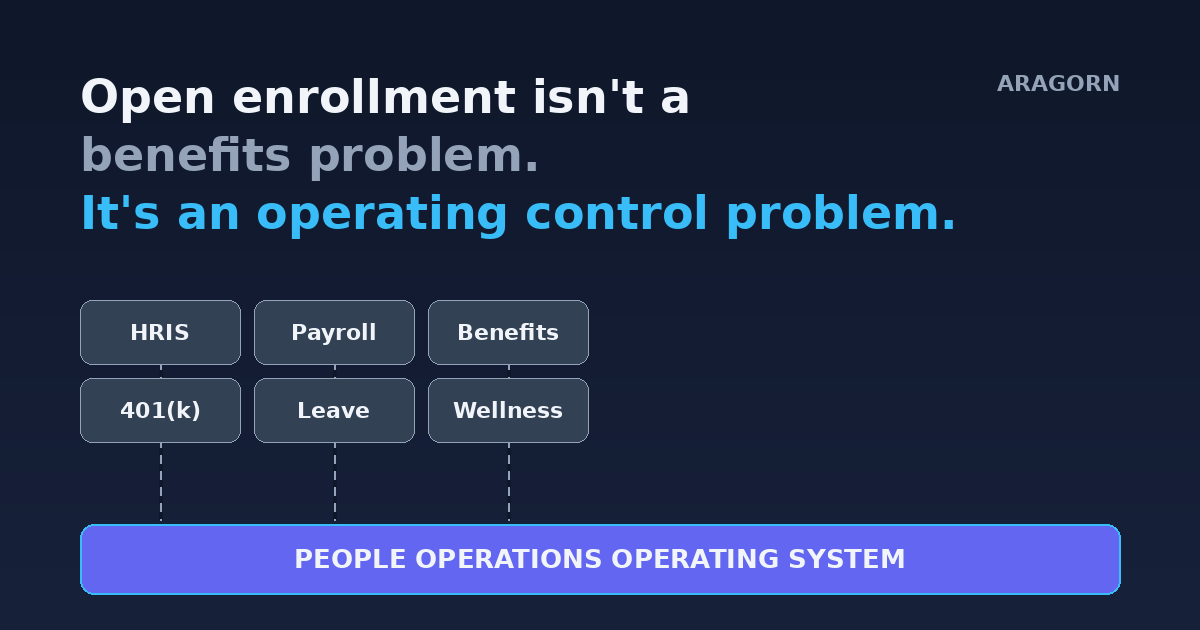
People Ops Operating System (definition): The control layer that sits beneath every HR application and owns how employee data moves, syncs, and recovers across systems. It is not an integration tool and not middleware. It is the operating layer HR runs on, the same way a company runs on an OS rather than on a collection of cables between apps.
The thing benefits leaders get blamed for is rarely the thing they control
Every fall, the same pattern repeats. Benefits teams spend months on the work they own: carrier negotiations, plan design, vendor selection, employee communication. Then enrollment opens and the failures show up somewhere else entirely.
An eligibility file does not update. A payroll deduction does not match the elected coverage. A vendor receives a partial employee record. A dependent disappears in a transfer between two systems that were never tested together.
The employee experiences a benefits problem. The root cause is an infrastructure problem. And the person held accountable, the VP of Benefits, is the person with the least authority over the systems that caused it.
This is the reframe that matters: open enrollment is not a benefits problem. It is an HR operating control problem. You can run a flawless benefits strategy and still have a failed enrollment, because enrollment outcomes are decided in the plumbing, not the plan design.
The old operating model is the disease, not the cure
Here is how most enterprises handle the plumbing today. When something needs to change or breaks, Benefits files a request with HRIS. HRIS queues it behind IT. IT routes it to a consultant or a vendor services team. A two-day fix becomes a two-quarter project.
That chain is not a temporary inconvenience. It is the operating model, and it has a name worth saying out loud: integration-as-a-project. Every connection is treated as a one-time implementation, handed off to whoever built it, and forgotten until it breaks under load. The load always arrives at the worst possible time, during open enrollment, when the volume and the stakes are highest.
The reason hiring another consultant or leaning harder on HRIS does not fix this is structural. Those moves add more one-time projects to a system that has no permanent owner. You cannot patch your way out of a missing operating layer.
The numbers behind the fragility
This is not a story about one bad file. It is a story about scale that has quietly outrun the operating model.
- The average organization now runs roughly 16 HR applications, and 68% of organizations still operate disconnected HR platforms, according to HR.com's 2025 State of HR Technology research. (HR.com)
- A single custom HRIS integration takes around six weeks to build, and ongoing maintenance consumes 60 to 70% of its total lifetime cost.
- HR teams working with siloed data report 31% higher error rates in employee data and spend roughly 23% more time on administrative work, with managers losing about 14 hours a week to manual reconciliation.
Every new vendor adds a connection. Every connection adds a failure point. What an employee sees as one enrollment screen is, underneath, dozens of systems exchanging data on different schedules under different rules. The larger you get, the more that network owns you instead of the other way around.
What an enrollment failure actually costs
Most teams measure enrollment problems in support tickets. That is the cheapest part of the bill. The real costs sit in four places, and only one of them shows up in a help desk queue.
Employee trust erodes first. People expect their healthcare and retirement elections to simply work, and when they do not, confidence in HR drops in a way no communication plan recovers quickly. Administrative burden compounds next, as Benefits, payroll, HRIS, and vendors burn weeks reconciling records by hand. Compliance exposure follows: incorrect eligibility or deductions are not just annoyances, and at least one midsize employer has faced six-figure tax penalties from misclassified contributions. (Inova Payroll) Finally, there is the cost no one invoices: vendor lock-in. Organizations keep underperforming vendors for years because the integration effort to switch feels too risky to attempt.
That last one is the quiet tax. When changing a vendor means rebuilding integrations from scratch, you are not choosing the best vendor. You are choosing the one you are already wired to.
The same problem is about to hit your AI roadmap
If the operating control problem only cost you one bad enrollment a year, you could live with it. It does not stop there. Every AI initiative HR is now being asked to deliver, predictive attrition, automated benefits guidance, total rewards personalization, depends on clean, governed, real-time employee data moving reliably across systems.
That is the exact capability the integration-as-a-project model cannot provide. An AI strategy built on infrastructure you do not control is a demo, not a deployment. The teams that solve operating control for open enrollment are the same teams that will be able to ship AI that works. The ones that do not will spend 2027 explaining why the pilot never made it to production.
Old model vs. operating model
| Integration-as-a-project | People Operations Operating System | |
|---|---|---|
| Ownership | No permanent owner; handed off | HR owns the operating layer |
| Vendor change | Quarters; rebuild from scratch | Weeks; reconfigure, do not rebuild |
| Visibility | Discovered when employees complain | Real-time view of every data flow |
| Failure handling | Manual reconciliation after the fact | Alerts before employees feel impact |
| AI readiness | Blocked by ungoverned data | Clean data as a standing capability |
The five questions that separate control from hope
You do not need to be the biggest company in your market to have operating control. You need to be able to answer these before enrollment opens, not during it:
- Which systems exchange enrollment data, and in what order?
- Where does each piece of employee information originate?
- What happens automatically when a file fails?
- Who gets alerted, and how fast?
- Can we change a vendor without starting integration over?
If you cannot answer all five, you do not have an enrollment plan. You have a hope, scheduled annually.
The one question to bring to your next leadership meeting
Here is the line worth putting in front of your CHRO: If a critical benefits integration failed tomorrow, how quickly would we know, and how quickly could we fix it?
The distance between those two answers is your operating control gap. It is also, increasingly, the difference between an enrollment season that runs quietly and one that becomes a company-wide fire drill. The organizations that win enrollment are not the ones with the best slide decks. They are the ones that own the layer everything else runs on.