You Already Run an iPaaS. Do You Still Need an HR Data Layer?
The Short Answer
If you already run a capable iPaaS, you do not need a second one. That is not what an HR data layer is.
An iPaaS moves data that someone has already defined. An HR data layer is where HR defines, governs, and controls its own data before any of it reaches the iPaaS. One is plumbing. The other is ownership. They sit in different places in the stack, and the good setups run both.
So the real question is not "another platform or not." It is "who owns HR data, and where does that ownership live." Answer that, and the tooling decision falls out of it.
The Question Behind the Question
Most teams arrive here through an argument, not a search. HR wants to fix the way its data moves. IT hears "new middleware" and pushes back, because they already have Boomi or MuleSoft or Workato and they are right to defend a working platform. The conversation stalls on tooling.
The reality is the disagreement is rarely about tools. It is about ownership.
HR data is not like the rest of the enterprise. It changes constantly with the org. It encodes business logic that lives in HR's head, things like effective dating, business unit and cost center derivation, calculated tenure, eligibility, and pay treatment. And HR is the only function that actually knows what any of it means.
That is the part IT cannot solve from its side, no matter how good the iPaaS is. You can hand a middleware team a feed and ask them to move it. You cannot hand them the judgment about what a field means when the plan year shifts or the business reorganizes. That judgment has to sit with HR. The tooling question is just where that judgment gets to live.
Why This Sounds Like a Turf Fight (and Why It Isn't)
Here is the thing. When HR shows up asking for control over its data, IT often hears a land grab. "You want to stand up a competing integration platform next to the one we already run." Stated that way, the answer is obviously no. Nobody wants two middleware platforms doing the same job.
But that framing is wrong, and it is usually what kills the conversation.
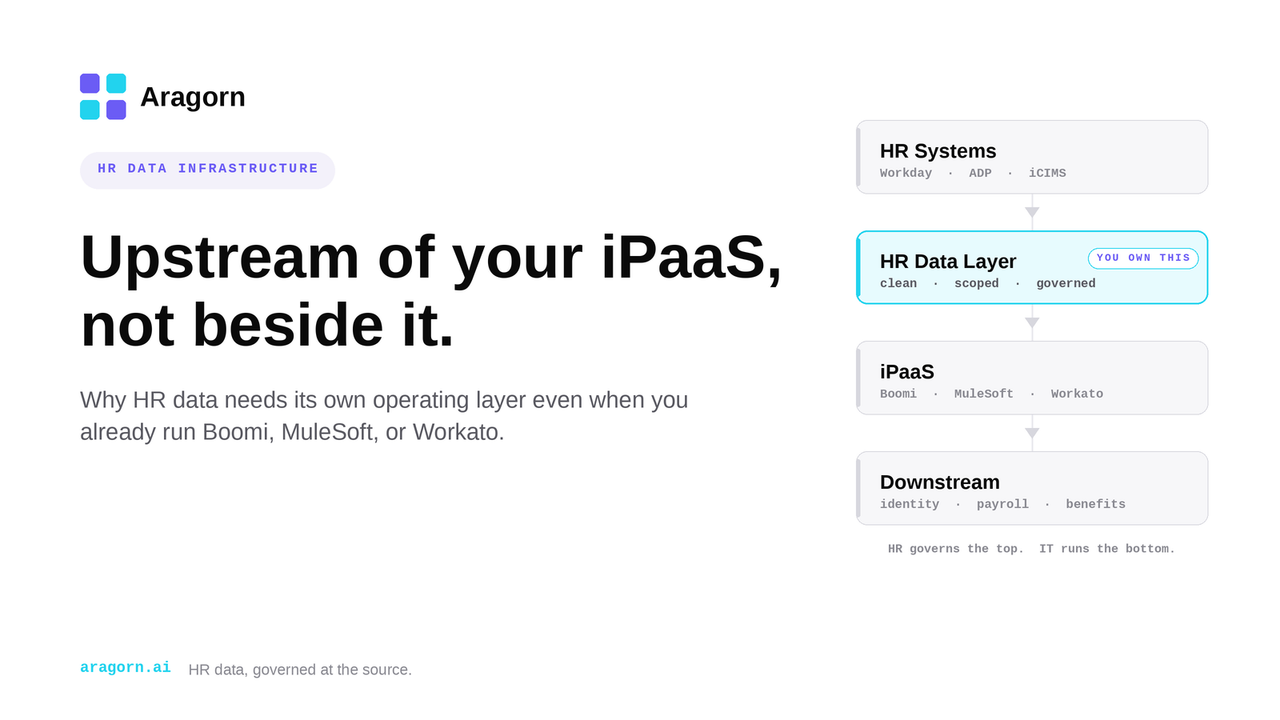
An HR data layer does not sit beside your iPaaS. It sits upstream of it. HR governs its data, cleans it, applies its own logic, scopes exactly what leaves the function, and then hands the iPaaS one clean, well-defined feed. The iPaaS keeps doing what it does best from there: identity, distribution, downstream systems.
Done right, IT's load goes down, not up. Instead of fielding tickets every time an HR field changes meaning, IT receives a stable, governed feed and stops being the bottleneck for HR's domain decisions. That is the reframe that unlocks the whole discussion.
What Your iPaaS Is Genuinely Good At
Give the iPaaS its due, because this matters for where you draw the line.
Boomi, MuleSoft, and Workato are strong at exactly what they were built for:
- Cross-functional integration. When a process spans finance, sales, HR, and operations, a central iPaaS owned by IT is the right home for it.
- Identity and access. Syncing core records to your identity provider, provisioning, single sign-on. Standard payloads, stable patterns, well-documented APIs.
- Distribution at scale. Once data is clean and defined, moving it to many downstream systems on a schedule or an event is squarely iPaaS territory.
- Enterprise governance for IT. Role-based access, environment promotion, execution logging, an integration practice run by people who do this full time.
If integration sits inside IT and the use cases are broad and standardized, the iPaaS is the right choice. None of what follows is an argument against that. It is an argument about where HR's specific work fits.
What an iPaaS Will Not Own for HR Data
The problem is not that an iPaaS is weak. It is that HR data integration needs a set of things that are domain decisions, not middleware features. An iPaaS can be told to do some of them. It will not own any of them. There is a difference.
Four areas where this shows up every time:
Business logic. Calculated fields like service tenure derived from employment history. Effective-dated transforms. Derived values that combine effective date, business unit, and cost center into the thing a downstream system actually needs. This logic changes when the business changes, and HR is the only one who can maintain it.
Data quality and ownership. Validating records at the source. Defining which system owns which field, so two systems are not silently fighting over the same value. Maintaining master data before anything moves. An iPaaS assumes the data it receives is already correct, but HR's problem starts one step before that.
Reliability built for HR work. Change data capture, so you refire only what actually changed instead of reprocessing everything. Quarantining a bad record instead of letting it poison the batch. Retry logic. Notifying HR fast, in terms HR understands, not a raw execution log nobody reads until something breaks. The failure mode without this is familiar: you are in week seven trying to debug a problem from week three, and the data has already moved on.
Audit and PII control. Field-level lineage. A time-stamped record of every change. The ability to reproduce exactly what you sent for a specific employee on a specific date. And scoping PII before it ever leaves HR, so you know precisely which fields cross the line and how they were transformed. This is the one most teams feel first, because PII moving through personal email and spreadsheets as a workaround is a risk everyone recognizes.
None of these are things you want to file as IT tickets as they are continuous HR judgments
Upstream, Not Beside It: Where the Line Goes
The clean version of the architecture is simple, and it ends the turf fight.
- HR systems (HRIS, payroll, benefits, ATS) feed into
- the HR data layer, where HR governs, cleans, applies logic, and scopes what leaves, which hands
- the iPaaS (Boomi, MuleSoft, Workato) one clean, scoped, audited feed, which runs
- downstream systems (identity, finance, benefits carriers, the rest).
HR owns the first two boxes. IT owns the last two. One well-defined feed crosses the boundary.
This is better for both sides and not a compromise position. HR gets control over the part it is accountable for and was never able to own. IT gets a stable input and stops being on the hook for HR's domain decisions. The iPaaS investment stays exactly where it is and keeps earning its keep.
"Can't We Just Build That in Boomi?"
This is the fair pushback, and it deserves a straight answer.
You can build pieces of it. A capable iPaaS team can script calculated fields, set up retries, and stand up some logging. The question is whether it is the right place for the work, and whether it holds up over time.
Three things tend to break the build-it-in-the-iPaaS approach for HR:
- It becomes one-size-fits-all. The hundred fields you push through middleware will not carry per-integration logic like "if this field updates for this benefits feed, refire only that one." You end up with a generic pipe and the nuance gets lost or hand-keyed back in.
- It does not get maintained. The team that built it is busy with the next thing. HR logic changes quietly, the build does not keep up, and you are back to forensic debugging and manual workarounds.
- HR still does not own it. Even if it works, the control sits with IT. Every change is a ticket. The dependency that started the whole conversation is still there.
The takeaway is iPaaS is the right place to move governed HR data, but not the place to govern it.
How to Tell If You Actually Need an HR Data Layer
Not every team needs this yet. If three or more of these are true, it is a signal that the conversation is worth having.
- Integration failures get discovered by employees, brokers, or carriers before HR sees them.
- A vendor change (new broker, new rewards platform, new ATS) turns into a multi-quarter project gated by IT or consultant capacity.
- PII is moving through personal email, text, or spreadsheets because the governed path is too slow or does not exist.
- You cannot reproduce, on demand, exactly what data you sent to a given system for a given employee on a given date.
- HR feeds carry only the minimum fields IT could justify building, usually enough for sign-on and not much else.
- "We will just hand-key it" has become a normal sentence in your team.
- You want to put AI or shared services on top of your HR data, and you do not trust the data underneath.
If none of these are true, you are probably fine with what you have. If most of them are, no amount of iPaaS tuning fixes it, because the gap is upstream of where the iPaaS operates.
The Bottom Line
If you already run a capable iPaaS, keep it as you do not need a second one.
What you may need is a layer upstream of it, where HR finally owns the data it has always been accountable for. Drawing that line is what ends the turf fight, takes load off IT, and gives HR control over the systems its work runs on.
That is the shift happening across HR functions right now, where it is not about tooling upgrade but about ownership change.
Aragorn is the operating layer for HR data. It sits upstream of your iPaaS and gives HR control over how workforce data is defined, governed, and monitored across HRIS, payroll, benefits, and rewards systems.