Alternative to Workato: The Definitive Guide for HR and People Operations Leaders
Quick answer: The best alternative to Workato depends on who owns the integration. If integration sits inside IT and the use case spans finance, sales, and operations, Workato is one of the strongest iPaaS choices. Boomi and MuleSoft fit enterprise IT integration practices. Celigo, Tray.ai, and Jitterbit serve mid-market and cost-conscious IT programs. Zapier Enterprise handles lightweight departmental workflows. Aragorn is the better fit when HR owns the integration outcome and needs operational control over workforce data across HRIS, payroll, benefits, and rewards systems.
Why HR Leaders Are Looking for a Workato Alternative
Most searches for an alternative to Workato look like a tooling question. They are usually an operating model question in disguise.
The HR systems leader asking is rarely shopping for a different iPaaS. They are trying to solve a specific operating problem. A Workday outbound feed to a 401(k) vendor fails over the weekend and no one notices until contributions miss the pay cycle. An ADP benefits file rejects a batch of dependent records and the broker emails the team before HR opens the ticket. A new recognition vendor was supposed to launch in Q1 and is still in integration design in Q3 because the build sits behind two other IT priorities. Open enrollment shifts left two weeks because the integration to UKG needed a consultant statement of work that took six weeks to scope.
When that pattern repeats often enough, HR leaders stop looking for a faster integration tool and start looking for a different operating model.
The reality is HR has been the only major business function without operating control over the systems that power its work. Finance has the GL. Sales has the CRM. Marketing has the marketing stack. HR has a constellation of vendors connected by integrations someone else owns. Workato did not create that gap. It is one of the better tools for closing it from the IT side. But IT cannot close the gap alone.
That is the lens this guide uses. It evaluates the alternatives honestly. It gives Workato credit where it earns it. And it draws the line where HR leaders should consider a different category of solution altogether.
The article covers what Workato does well, why companies start looking for Workato alternatives, the seven competitors that show up most often in HR integration platform evaluations, a comparison table, a direct view of Workato versus Aragorn, the Workato vs Boomi and Workato vs MuleSoft picture from an IT lens, and the strategic shift happening across HR functions in 2026.
What Workato Does Well
At a glance: Workato is a low-code integration platform as a service (iPaaS) used to connect SaaS applications, automate workflows, and move data between systems. It is strong for IT-led integration teams, broad cross-functional automation, and organizations standardizing on one platform across finance, sales, marketing, and operations.
Workato is one of the more capable iPaaS platforms on the market, recognized as a Leader in Gartner's Magic Quadrant for Integration Platform as a Service across multiple consecutive years. That credibility is worth naming clearly before any comparison.
The platform has a deep connector library, supports event-driven and scheduled patterns, and handles enterprise governance with role-based access, audit logs, and environment promotion. Its recipe model is approachable for business technologists, and the company has invested in conversational and AI-assisted automation. For companies that have built an integration center of excellence inside IT, Workato is one of the most defensible choices.
Three use cases it handles well:
Cross-functional process automation. Lead-to-cash, quote-to-cash, hire-to-retire as workflow orchestration, IT service management. Anywhere a process spans Salesforce, NetSuite, Slack, Jira, ServiceNow, and Marketo, Workato fits cleanly.
Data movement between SaaS systems. Customer data syncs, contract data syncs, opportunity data syncs. Standard payloads, well-documented APIs, predictable patterns.
Citizen developer programs. When IT wants to extend integration ownership to business analysts without giving up governance, Workato has one of the better models for that.
The pattern across those use cases is consistent. Workato is at its best when integration is owned by a central team that thinks in workflows and recipes, when data structures are mostly standardized, and when the cost of an integration failure is measured in inconvenience rather than payroll errors or regulatory findings.
That is exactly the territory it was designed for. The question is whether HR work fits that territory.
Why Companies Start Looking for an Alternative to Workato
Direct answer: Companies look for alternatives to Workato when integration ownership shifts from IT to a business function, when use cases require deep domain logic such as payroll, benefits, compensation, and eligibility, when platform fees grow faster than the value they produce, or when operational reliability and observability matter more than workflow flexibility. The HR function is one of the more common drivers of this shift in the conversations we hear from HRIS leaders.
There are five recurring reasons HR systems leaders begin evaluating alternatives. Each one shows up in real deals. Most appear together.
1. HR Integrations Quietly Become Engineering Projects
The first ten integrations are fine. By the fortieth, every vendor change, benefits update, payroll connection, downstream feed from Workday or ADP or UKG, and ad hoc reporting workflow has a queue.
HR rarely staffs integration engineers. So the queue lands on IT, an outside consultant, or the HRIS vendor's professional services arm. A typical pattern: a Total Rewards leader signs a new recognition vendor in February with a Q2 launch plan. The integration into Workday for eligibility and into ADP for any spot-bonus payouts gets scoped in March, scheduled in April, built in May, and tested in June. The launch slips to Q3 and the Total Rewards team carries a quarter of unused vendor spend.
The platform did not fail. The operating model failed. HR is accountable for an outcome and dependent on someone else for the execution.
2. Payroll, Benefits, and Compensation Logic Is Not Generic Workflow
A general iPaaS treats data as cargo. HR data is not cargo. It is policy, eligibility, hours, pay codes, tax treatment, deductions, and dependents, all carrying compliance weight.
Payroll integrations need pay-period awareness, retroactive correction logic, and reconciliation that catches discrepancies before the bank file is cut. Benefits integrations need plan year awareness, life event handling, dependent eligibility, COBRA, and HSA contribution logic. Compensation integrations need merit cycles, equity refresh cycles, and approval routing.
A workflow tool can model all of this. The question is who maintains the model when the broker changes, when the plan year shifts, when payroll moves from biweekly to weekly. In an IT-owned model, those changes become tickets. In an HR-owned model, they need to be configuration.
3. HR Often Has Limited Visibility Into What Its Systems Are Doing
In many HR organizations, integration failures are discovered by employees. A 401(k) contribution file fails on Friday night. An employee notices a missing dependent on benefits on Monday morning. The broker emails the benefits team on Tuesday. The HRIS team opens a ticket on Wednesday. IT confirms the failure on Thursday. By then the file has missed two payroll cycles, the carrier reconciliation report shows a variance, and HR is in damage control.
That is not a tooling problem. It is an observability problem. HR is operating critical infrastructure without monitoring designed for HR work. Generic iPaaS platforms produce execution logs, but execution logs are not the same thing as operational visibility built around employee lifecycle events, plan-year cycles, and pay-period boundaries.
4. Vendor Changes Become Multi-Quarter Projects
Switching a benefits broker. Adding a recognition or rewards vendor. Migrating from one ATS to another. Onboarding a new payroll provider after an acquisition. In an IT-led integration model, every one of these requires a project. Statements of work. Consultant kickoff. Discovery. Build. Test. UAT. Cutover. Reconciliation.
Three months becomes six. Six becomes nine. The business case for the vendor change erodes inside the implementation. By the time the new broker is live, the renewal cycle that justified the switch has already turned, and the savings model in the original deck no longer reflects reality.
This is where vendor agility becomes a board-level concern. HR organizations are being asked to deploy programs faster, but the infrastructure underneath them moves at the speed of consulting capacity.
5. Platform Cost Outgrows the Business Case
Workato is priced as an enterprise iPaaS. That pricing is fair given the platform's depth, especially when integration is shared across many functions. For HR-only use cases, the cost per integration can look high relative to the value, particularly when the IT integration team has already capitalized its platform investment against broader, cross-functional use cases.
When HR leaders look at the share of platform spend their function is consuming and compare it to the consultant and IT dependencies they still have, the value equation gets tested. That is when the alternative-to-Workato search starts in earnest.
The 7 Best Alternatives to Workato in 2026
The short version: The seven Workato alternatives that show up most often in HR integration platform evaluations are Aragorn (the HR operating layer), Boomi (enterprise iPaaS), MuleSoft (API-led integration for engineering teams), Celigo (mid-market SaaS iPaaS), Tray.ai (automation-first iPaaS), Jitterbit (cost-conscious enterprise iPaaS), and Zapier Enterprise (lightweight workflow automation). Right fit depends on who owns the integration, the domain the use cases live in, and the governance posture required.
The shortlist below is built around what shows up in real HR systems evaluations, not a comprehensive market map. Each entry names what the platform is good at, where it struggles, and the buyer profile it fits.
1. Aragorn: The People Operations Operating System
Best for: HR systems, payroll, benefits, and total rewards teams that need operational control over how workforce data moves, is structured, and is monitored across HRIS, payroll, benefits, rewards, and ATS systems.
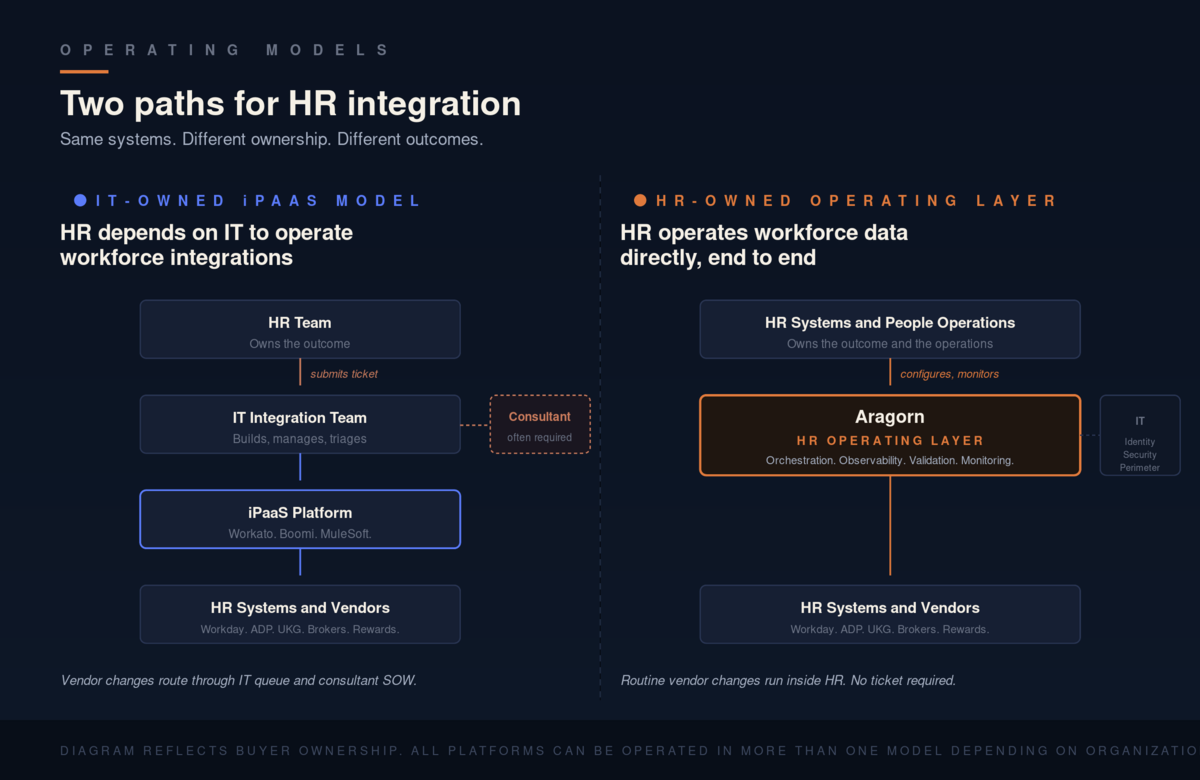
Aragorn is not an iPaaS. It is an operating layer designed for HR. It sits between Workday, ADP, UKG, Dayforce, Paycom, BambooHR, Paylocity, the ATS, the benefits administrator, the broker, the rewards vendors, and the analytics stack. It controls how data moves between them, how it is structured, and how it is observed.
What changes operationally when HR runs this layer:
Integration ownership shifts to HR without losing governance. The HR systems team configures, validates, and monitors workflows directly. IT retains the security perimeter, identity, and infrastructure. Routine vendor changes stop needing a consultant statement of work to move.
Observability is shaped around HR work, not just the technical job. Failed feeds, missed records, eligibility mismatches, and reconciliation variances surface to HR before they reach employees, brokers, or finance. The team operates the way a modern engineering team operates a production system: dashboards, alerts, and ownership rather than tickets.
Vendor changes get shorter. Onboarding a new benefits administrator, switching a recognition vendor, or replacing a background check provider stops being a multi-quarter project for the HR functions that have moved to this model. Reference customers including Plaid, Oak View Group, and The Friedkin Group operate workforce data on Aragorn at enterprise scale.
Where Aragorn is not the fit: organizations that need a single integration platform across finance, sales, IT, and marketing. Aragorn is built for HR. A general iPaaS still has a job to do for the rest of the business, and Aragorn is comfortable sitting next to one rather than replacing it.
2. Boomi
Best for: Large enterprises with a centralized integration team and broad cross-functional use cases. A natural Workato vs Boomi comparison sits inside IT, not HR.
Boomi is one of the longest-tenured iPaaS platforms in the market. It has a broad connector library, mature governance, and strong support for hybrid and on-premise systems. Companies that already standardize on Boomi for ERP and finance integrations often consider expanding it into HR.
The trade-off is implementation effort. Boomi rewards a team that knows how to model integrations, manage environments, and run an integration practice. HR functions rarely staff that team. Boomi typically ends up sitting inside IT, which puts HR back in the dependency loop the alternative-to-Workato search was supposed to resolve.
Boomi is the right choice when integration is a central IT function and HR is one of many internal customers. It is the weaker choice when HR is trying to take ownership and needs domain-aware tooling.
3. MuleSoft
Best for: API-first organizations with strong engineering capacity that treat integration as a long-term architectural investment. A Workato vs MuleSoft comparison usually comes down to time-to-recipe versus long-term platform depth.
MuleSoft was acquired by Salesforce in 2018. The platform is closer to an integration framework than a finished iPaaS. The API-led design pattern works well for organizations that have the engineering capacity to support it.
For HR, MuleSoft surfaces a familiar problem. It moves the data, but the HR domain logic, eligibility rules, pay-period awareness, open enrollment edge cases, and reconciliation patterns, has to be built and maintained. That work either lives in IT, which creates dependency, or in a consultant's statement of work, which creates cost.
If a company has already committed to MuleSoft as a strategic platform, the question is whether to extend it into HR or layer an HR operating system on top of it. The two are not mutually exclusive.
4. Celigo
Best for: Mid-market organizations with mature SaaS portfolios and ERP-heavy integration needs.
Celigo's integrator.io platform is well-known for its NetSuite ecosystem strength and prebuilt integration apps. It often shows up in evaluations against Workato when the buyer wants a faster path to stand-up.
Celigo's prebuilt integration apps compress time-to-value for common SaaS pairings, particularly in the NetSuite, Salesforce, and Shopify orbit. For HR-specific work, the prebuilt content is thinner. HR buyers tend to treat Celigo as a credible iPaaS that is not specialized for workforce data.
5. Tray.ai
Best for: Operations-led teams who want low-code workflow automation across a sprawling SaaS stack, particularly with an AI agent layer.
Tray.ai rebranded from Tray.io to reflect its move toward AI-led automation. The platform is flexible and tends to win in revenue operations and customer operations use cases where flexibility matters more than deep domain modeling.
For HR, the same observation applies as with most iPaaS platforms. Tray.ai can model HR workflows. Maintaining those workflows still requires a team that thinks in integration logic. That team rarely sits inside HR.
6. Jitterbit
Best for: Cost-conscious enterprise buyers and organizations modernizing legacy on-premise integration estates.
Jitterbit is often selected when buyers want enterprise-grade integration capability without the cost profile of Boomi or MuleSoft. It is strong on hybrid integration and has invested in API management as a complement to iPaaS.
It is a credible Workato alternative for IT-led programs. For HR-owned programs, it carries the same domain gap as other general iPaaS platforms. The platform is capable. The operating model is still IT-led.
7. Zapier Enterprise
Best for: Lightweight, departmental, and citizen-developer automation across a wide tail of SaaS apps. This is the right choice for tactical HR workflows, not for core workforce data infrastructure.
Zapier is one of the most recognized names in workflow automation, and its enterprise tier adds governance, SSO, and team management. It works well when the use cases are tactical: notifications, lightweight data syncs, internal alerts, simple lifecycle triggers between standard SaaS apps.
Zapier Enterprise is not in the same competitive set as Workato or an HR operating layer for core workforce data. Where it fits inside an HR portfolio is in the long tail of small workflows that would not justify a heavier platform.
Workato Alternatives Comparison Table
In brief: Workato, Boomi, MuleSoft, Celigo, Tray.ai, Jitterbit, and Zapier Enterprise are general or mid-market iPaaS platforms designed primarily for IT-led integration programs. Aragorn is purpose-built for HR ownership of workforce data infrastructure and sits in a different category. Use both side by side when the company is large enough to need both layers.
The comparison below is intentionally not a feature checklist. Feature checklists make every vendor look similar and obscure the operating model differences that actually matter to a buyer.
| Dimension | Workato | Boomi | MuleSoft | Celigo | Tray.ai |
|---|---|---|---|---|---|
| Primary buyer | IT, Integration CoE | IT, Integration CoE | IT, Engineering | IT, RevOps | RevOps, Operations |
| Category | iPaaS | iPaaS | Integration platform | iPaaS | iPaaS |
| Workforce data domain depth | General | General | General | General | General |
| Payroll-aware logic | Built by customer | Built by customer | Built by customer | Built by customer | Built by customer |
| Benefits-aware logic | Built by customer | Built by customer | Built by customer | Built by customer | Built by customer |
| Observability framing | Recipe logs | Process logs | Flow logs | Flow logs | Workflow logs |
| Owns the integration | IT | IT | IT or Engineering | IT or RevOps | RevOps |
| Typical implementation owner | Internal IT or partner | Internal IT or partner | Internal Engineering or partner | Internal or partner | Internal |
| Consultant dependency for ongoing changes | Common | Common | Common | Lower | Lower |
| Fit for cross-functional automation | Strong | Strong | Strong | Moderate | Strong |
| Fit for HR-owned workforce data control | Possible with effort | Possible with effort | Possible with effort | Possible with effort | Possible with effort |
The table is not scoring vendors. It is naming who each one was designed to serve and what each one requires the buyer to bring. The pattern is consistent across the iPaaS column. Strong platforms. IT-shaped operating model. HR has to translate every HR concept into integration logic. That translation cost is the hidden tax.
Workato vs Aragorn: A Comparison of Operating Models, Not Features
The short version: Workato and Aragorn solve different problems. Workato is a general iPaaS designed for IT-owned integration programs. Aragorn is an operating layer designed for HR-owned workforce data control. The two are often used together: Workato for cross-functional workflow automation owned by IT, Aragorn for HR-specific operational control owned by HR Systems and People Operations.
The real comparison between Workato and Aragorn is not feature-by-feature. It is who runs the system and what they are responsible for when something breaks.
In a Workato-led model, integration lives inside IT. IT picks the platform, builds the recipes, runs the monitoring, and triages failures. HR submits requirements, signs off on test cases, and receives a finished workflow. When a vendor changes or a plan year shifts, HR opens a ticket. The work is good. The operating dependency is real.
In an Aragorn-led model, the operating layer is owned by HR Systems. HR configures the workflows directly, monitors them through HR-shaped dashboards, and resolves issues without routing through IT. IT still owns the security perimeter, identity, and infrastructure. But the day-to-day operation of HR data movement, validation, and observability lives where the accountability lives.
That is the meaningful difference. It is not which platform has more connectors. It is whether the function accountable for the outcome controls the system.
A few practical implications of that shift:
Time-to-launch for vendor changes shortens. Benefits broker switches, recognition vendor onboarding, and payroll provider migrations stop sitting in an IT queue. Customers operating in this model have reported meaningful compression on vendor onboarding cycles.
Consultant spend declines. The recurring spend on HRIS implementation partners for routine integration work drops because the work itself moves inside the HR function. The implementation partner relationship becomes strategic again, not transactional.
Failure modes shift earlier in the chain. HR sees a broken Workday outbound feed, a failed ADP file, or a UKG sync error before an employee or a broker does. The reactive posture HR has carried for years becomes a proactive posture, which is what every CHRO wants and few have the infrastructure to support.
The two models are not mutually exclusive. A company can run Workato inside IT for cross-functional automation and run Aragorn inside HR for workforce data control. In larger organizations, that combination is increasingly the pattern.
What matters is naming the choice. If integration is treated as a single IT capability covering all functions, Workato is a strong pick. If HR is being asked to operate like a real-time business function and is being held accountable for outcomes it does not control, the answer is not a better iPaaS. It is a different category of system.
Workato vs Boomi and Workato vs MuleSoft: The IT Lens
The IT view: Workato, Boomi, and MuleSoft are three of the most established integration platforms for enterprise IT. Workato is typically the easiest to adopt for citizen developer programs and cross-functional automation. Boomi is strong for enterprise governance and hybrid integration. MuleSoft is the heaviest and most engineering-led of the three, fitting organizations that treat integration as a long-term architectural investment.
For an IT or integration leader, the comparison among these three is well-trodden territory. The summary version:
Workato wins on time-to-recipe and citizen-developer adoption. Its conversational and AI-assisted automation has set the pace for the category. The trade-off is that very deep custom logic still requires a real platform skill set.
Boomi wins on enterprise estate. If a company has years of integration history in Boomi and a mature integration practice, the case for adding Workato has to clear a high bar. Boomi's hybrid integration story is also stronger.
MuleSoft wins on long-term architectural strategy. The API-led approach pays off when integration becomes a strategic capability that the company expects to lean on for a decade. The cost is the longer ramp and the heavier engineering investment.
For HR specifically, the IT-lens comparison is mostly informational. The HR systems leader does not get to choose between Workato, Boomi, and MuleSoft. The choice was made by IT years ago, usually for reasons that have nothing to do with HR. The real question for HR is whether to extend whichever IT platform was chosen into HR work, or to put an HR-specific operating layer on top of it.
The Bigger Shift Happening in HR
The shift: The largest structural shift in HR technology is the move from HR as a consumer of integrations to HR as an operator of its own data infrastructure. Generic iPaaS platforms support the first model. An HR-purpose-built operating layer, sometimes called a People Operations Operating System, supports the second. The shift is being driven by AI readiness, executive reporting cadence, vendor agility, and the cost of consultant dependency.
For most of the last decade, HR has been told it needs better data. That framing is incomplete. HR has had access to plenty of data. What it has not had is operating control over the systems that produce, transform, and deliver that data.
Three forces are now making that control non-optional.
The first is AI. Every AI initiative HR is being asked to support, copilots for managers, predictive turnover, internal mobility, workforce planning, depends on trusted, well-structured workforce data. AI on bad data is worse than no AI. The function that owns the data plumbing owns the AI roadmap. Right now, that function is usually IT.
The second is executive reporting cadence. Boards and CEOs want real-time workforce visibility. Headcount, attrition, comp, hiring velocity, engagement, all updated weekly or daily. The cadence required to support that has outstripped the integration speed most HR functions can offer through their current operating model.
The third is vendor agility. Modern HR is a vendor portfolio. Brokers, rewards providers, learning platforms, recognition tools, recruiting platforms, background check vendors. The function with the fastest vendor switching speed has the best employee experience and the lowest cost. The function stuck in multi-quarter implementation cycles loses ground.
None of this is solved by buying a different iPaaS. The pattern that solves it is HR taking operational ownership of the layer between its systems, with tooling that speaks HR natively. Aragorn is one of the platforms building toward this. It is the same shift finance went through when it took ownership of the close, that engineering went through when it took ownership of production, and that sales went through when it took ownership of the CRM.
The takeaway is simple. The next decade of HR will not be defined by which HRIS a company runs. It will be defined by whether HR controls the operating layer above its systems.
How to Choose Between an iPaaS and an HR Operating Layer
The decision frame: Choose an iPaaS like Workato, Boomi, or MuleSoft when integration is owned by IT, when use cases span multiple business functions, and when domain logic is general. Choose Zapier Enterprise when the use cases are lightweight departmental workflows. Choose an HR operating layer like Aragorn when HR owns the integration outcome, when use cases involve payroll, benefits, eligibility, or workforce data, and when consultant or IT dependency is the bottleneck.
A short decision frame for HR systems leaders:
If integration is an IT capability and HR is one of many internal customers, pick the best iPaaS for your IT team and accept the operating model that comes with it. Workato, Boomi, and MuleSoft all fit this profile.
If HR is accountable for the outcome of integrations but not in control of them, the answer is not another iPaaS. The answer is an HR integration platform that gives HR direct operational control, with the HR domain logic built in rather than configured on top.
If the company is large enough to run both, that is the path increasingly seen in larger HR organizations. IT owns its iPaaS for cross-functional automation. HR owns its operating layer for workforce data. The two cooperate at the boundary. Identity and security stay with IT. Operating speed moves to HR.
The mistake to avoid is treating the integration problem and the HR operating problem as the same problem. They are not. They have different buyers, different domain requirements, different failure modes, and different success metrics.
Final Recommendation
If integration is owned by IT and the scope spans the entire business, Workato is one of the strongest platforms in the category and will not be displaced for HR-only reasons. Boomi and MuleSoft are credible peers depending on the IT operating model. Celigo, Tray.ai, and Jitterbit are credible mid-market or cost-conscious choices. Zapier Enterprise covers the long tail of lightweight workflows.
If HR is accountable for workforce data outcomes but does not control the systems that produce them, the answer is not a better iPaaS. The answer is an HR integration platform that gives HR direct operational control, with the HR domain logic built in rather than configured on top. That is the role Aragorn is built for.
The choice this guide exists to surface is straightforward. Workato is excellent at what it was built for. HR is increasingly being asked to operate like a real-time business function. The systems that support that work have to be owned by HR. That is a different category of decision than choosing between iPaaS vendors.
The starting point for HR leaders is concrete. Map your current vendor estate. Identify the three integrations that fail most often, take longest to launch, or sit in the longest consultant queue. Decide whether the bottleneck is the platform or the operating model. If it is the platform, evaluate the iPaaS shortlist above. If it is the operating model, the category has moved, and the next step is below.